Building a quiz that talks back
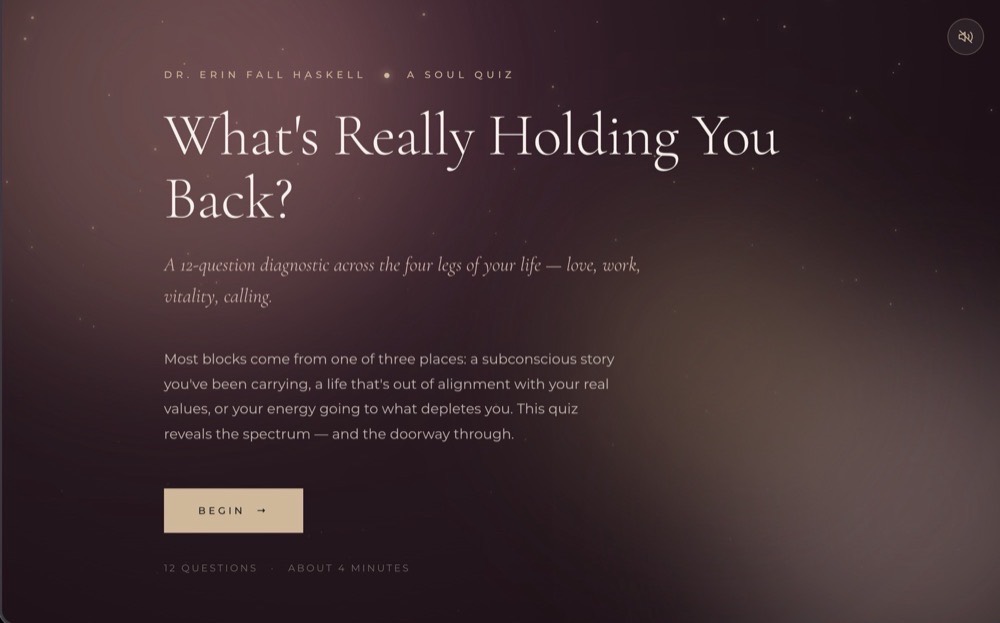
Erin asked for something I had not built before. When you finish her quiz, the result reads itself out loud. In her voice.
Not a stock narrator doing a warm impression. Hers, the one her audience already knows from the show.
The brief
Twelve questions. Four areas of life against three kinds of block, so thirty six datapoints, weighted to land on a spectrum instead of dropping everyone into one of four buckets. Name and email just before the reveal.
Then the part that made it worth building. The result speaks.
What we built
The quiz itself is unremarkable. Questions in a JSON file, a scoring pass at the end, entries written server side and surfaced in a dashboard she can export from.
The voice is a cloned model, trained on her own recordings, with her permission. We send it the result text and get audio back.
The first version called the service every time somebody finished. Fine for a demo, expensive for a lead magnet you want thousands of people to take. So we cache. The key is a hash of the voice, the model and the exact text. Same result, same file, no second charge. Change one word of the copy and it regenerates, which is a small tax on editing and worth paying.
The part that took longest
Her voice came back too quiet. Not slightly. About twenty decibels below where it needed to sit, which meant it was fine on headphones and almost inaudible on a phone in a kitchen.
That one took a while, because nothing was broken. The audio played. It just felt wrong in a way that is hard to describe and easy to measure, once you think to measure it. The clone had been trained on quiet recordings, so it faithfully produced quiet. Every file now gets normalised to a fixed loudness before it goes in the cache.
Then the pauses. Read aloud, the result ran together into one long breathless sentence. A person pauses between a name and a sentence, and again between paragraphs. The model does not, unless you tell it to. So we put the breaks in ourselves, before the text ever reaches the voice.
Small thing. It is also the difference between a machine reading a paragraph and someone talking to you.
Where it ended up
If the voice service is ever unavailable, the quiz stays quiet and carries on. Nobody sees an error. That mattered for something a person meets once and judges immediately.
The part I think about is watching someone take it for the first time. They answer twelve questions, the result appears, and then it starts speaking, and they look up. Not at the screen. Up, like somebody just walked into the room.
You can try it at quiz.drerin.tv.